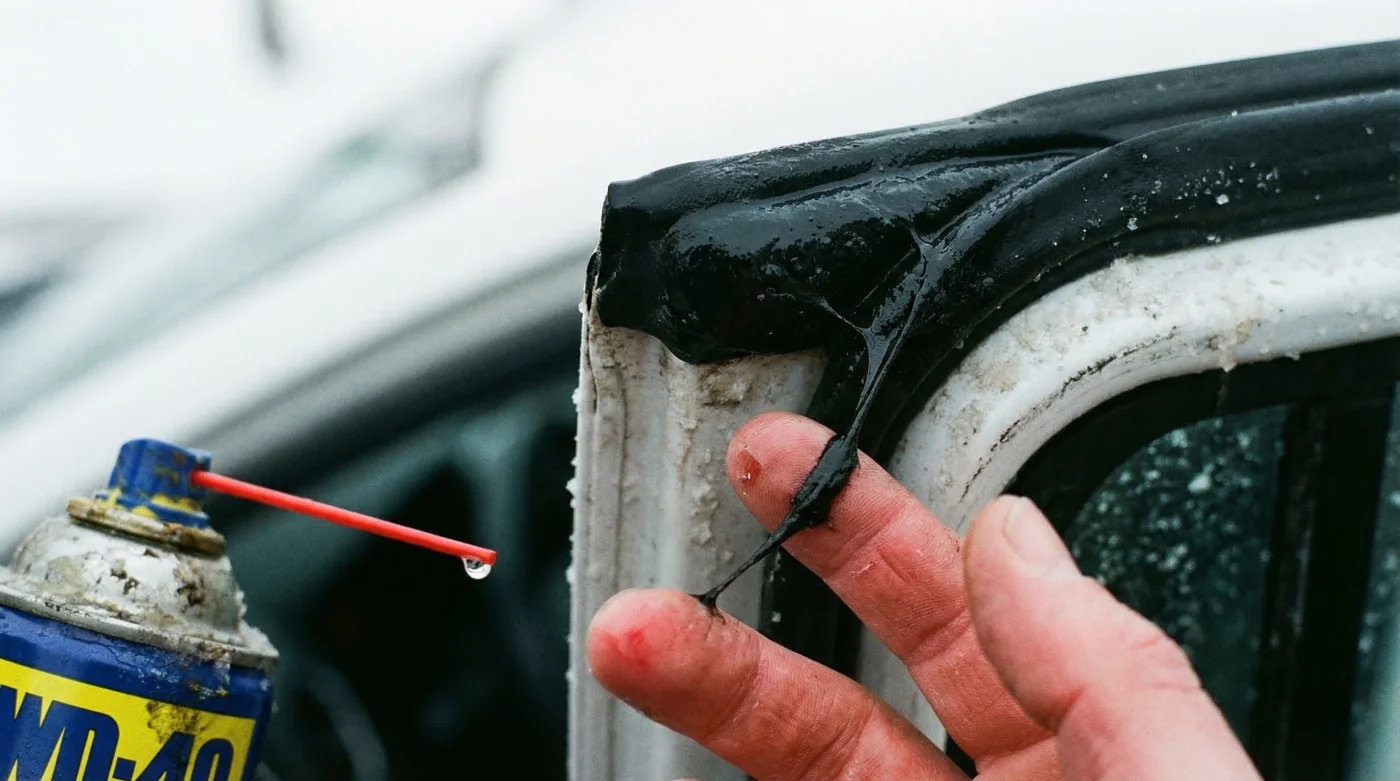
As the harsh British winter sets in, bringing with it bitter winds, sleet, and plunging overnight temperatures, millions face the dreaded morning ritual of frozen car doors. In a desperate bid to unstick weatherseals before the chaotic daily commute, countless motorists instinctively reach for the iconic blue and yellow tin from their garage shelf, assuming it is the ultimate winter driving hack. However, this seemingly innocent seasonal habit is quietly causing hundreds of pounds in irreversible damage to modern vehicles across the United Kingdom.
Behind garage doors, mechanics and automotive specialists are currently witnessing a massive surge in a specific type of costly structural wear-and-tear, all stemming from one catastrophic chemical misunderstanding. While this world-famous multi-purpose spray is virtually unparalleled at displacing moisture, silencing squeaky hinges, and freeing rusted metal bolts, applying it to your vehicle’s delicate weatherstripping initiates a silent, devastating molecular reaction. It is a hidden habit that entirely destroys the protective material from the inside out.
The Hidden Chemistry Destroying Your Doors
To understand precisely why this happens, we must examine the intricate anatomy of modern automotive manufacturing. The vast majority of vehicle door, boot, and windscreen seals produced in the last two decades are manufactured from Ethylene Propylene Diene Monomer, commonly referred to as EPDM rubber. This highly advanced synthetic elastomer is specifically engineered and prized for its exceptional resistance to ozone, UV light, and the relentless wet-to-freeze fluctuations of typical UK weather. However, standard multi-purpose maintenance sprays are heavily formulated with aggressive petroleum distillates. When these heavy, oil-based solvents come into direct contact with EPDM, a severe chemical incompatibility occurs immediately. Experts advise that the petroleum aggressively penetrates the porous cellular structure of the seal, causing it to swell dramatically, warp out of shape, and ultimately perish.
The Symptom vs Cause Diagnostic Guide
- Symptom: Spongy, sticky, or melting black residue transferring onto door frames and hands. = Cause: Severe solvent degradation breaking down the elastomeric cross-bonds of the rubber.
- Symptom: Increased wind noise and freezing cold draughts when driving on the motorway. = Cause: Extreme seal shrinkage and warping post-swelling, leading to a permanent loss of structural integrity and air-tightness.
- Symptom: Car doors freezing shut more severely and frequently than before. = Cause: The degraded, failing rubber becomes hyper-porous, trapping excess microscopic water vapour from the atmosphere which then rapidly freezes overnight.
| Vehicle Type & Age Bracket | Most Vulnerable Components | Estimated Replacement Cost (£) |
|---|---|---|
| Modern Hatchbacks (2015-Present) | Primary perimeter weatherstripping | £150 – £250 per door |
| Luxury Saloons & SUVs (2010-Present) | Acoustic multi-layer door & boot seals | £400 – £800 complete set |
| Classic Cars (Pre-2000 Era) | Natural rubber window and boot linings | £100 – £300 (Parts critically rare) |
- Bathroom humidity destroys expensive Vitamin C serums within fourteen days
- Professional detailers apply Autoglym resin polish in straight vertical lines only
- White vinegar neutralises baking soda cleaning properties during bathroom scrubbing routines
- WD-40 silicone spray degrades natural rubber windshield wiper blades instantly
- Dyson engineers warn against washing HEPA filters with warm soapy water
Why Standard WD-40 is the Wrong Tool for Winter Maintenance
Clinical studies in automotive polymer engineering prove that applying standard penetrating oils to synthetic rubbers accelerates structural degradation by up to 400% when compared to natural atmospheric weathering. The primary mechanism of action for traditional WD-40 relies heavily on highly volatile aliphatic hydrocarbons. While absolutely brilliant for metal-on-metal lubrication and rust prevention, these exact compounds act as a severe and aggressive plasticiser when introduced to EPDM rubber. The potent solvent immediately strips away the protective factory-applied UV coatings, violently leaching the essential conditioning oils out of the rubber matrix. Within mere weeks of application, the once-supple and flexible weatherseal becomes a brittle, hardened, and shrunk strip that inevitably cracks under the heavy mechanical pressure of a closing car door.
The Top 3 Winter Maintenance Mistakes
- The Blind Spray: Liberally dousing the entire door frame and lock mechanism with water-displacement fluid without checking the chemical base or reading the manufacturer’s warning labels.
- The Over-Application: Using more than 10ml of any chemical product per door seal, which inevitably leads to heavy liquid run-off that can severely stain and degrade your exterior clear-coat paintwork.
- The Frozen Force: Violently pulling and jerking a stubbornly frozen door handle, which forcefully tears the micro-fractured, weakened rubber directly away from its expensive adhesive backing.
| Chemical Base Profile | Interaction with EPDM Rubber | Degradation Timeframe | Safe Operating Temperature |
|---|---|---|---|
| Petroleum Distillates | Severe cellular swelling and total structural breakdown | 14 to 28 days | Not applicable (Fundamentally unsafe at any temp) |
| Lithium Grease | Mild surface softening, acts as a magnet for abrasive road grit | 3 to 6 months | Strictly above 0°C |
| 100% Pure Silicone | Deeply nourishes, instantly repels moisture without swelling | Indefinite ongoing protection | -40°C to +200°C |
Understanding the strict chemical limitations of your household garage chemicals is the only reliable way to pivot toward the correct, professional-grade preventative measures that will actually protect your vehicle.
The Silicone Solution: Protecting Your Vehicle’s Lifespan
To safely and effectively winterise your vehicle, ensuring your doors open effortlessly on even the most punishing freezing mornings, industry experts advise pivoting exclusively to 100% pure silicone spray or a dedicated fluoropolymer dry lubricant. Unlike aggressive petroleum-based alternatives, premium high-grade silicone is totally chemically inert when it meets EPDM rubber. Instead of penetrating and destroying the core, it sits entirely on the surface layer, creating an invisible, impermeable hydrophobic barrier. This microscopic shield completely prevents water from settling and freezing, while simultaneously conditioning the underlying rubber to maintain its vital, factory-level elasticity.
Actionable Application Protocol
For maximum efficacy and to avoid unnecessary mess, do not spray the product directly from the tin onto the car’s bodywork. Instead, adhere strictly to this exact dosing protocol: Wait for a relatively mild, dry afternoon where the ambient temperature is steadily above 5°C. Clean the rubber weatherseal thoroughly with warm, mild soapy water and dry it completely with an ultra-absorbent microfibre cloth. Apply exactly 3ml to 5ml of 100% pure silicone spray directly onto a clean detailing sponge or precision applicator pad. Firmly and evenly massage the silicone liquid into the weatherseal, covering exactly one linear metre at a time to ensure total saturation of the surface pores. Allow the treatment to cure undisturbed for exactly 15 minutes before closing the doors; this critical window ensures the siloxane chemical bonds fully cross-link with the rubber surface.
| Product Formulation Type | What To Look For on the Label | What To Absolutely Avoid | Correct Application Method |
|---|---|---|---|
| Aerosol Lubricants | ‘100% Pure Silicone’, ‘Certified Rubber Safe’ | ‘Multi-purpose’, ‘Penetrating fluid’, ‘Contains petroleum’ | Apply via soft sponge, never use a direct spray nozzle |
| Thick Gel Protectants | High viscosity rating, added UV protection | Petroleum jelly (Vaseline destroys rubber equally fast) | Vigorously massage exactly 5g per door seal |
| Dry PTFE Sprays | Polytetrafluoroethylene base ingredient | Graphite-heavy powders (causes severe messy staining on paint) | Light 2-second targeted burst directly onto a microfibre cloth |
By intelligently swapping out your traditional water displacement fluid for a highly targeted, scientifically backed silicone treatment, you will forever banish the immense stress of frozen winter mornings while diligently safeguarding your vehicle’s expensive structural infrastructure.
Read More