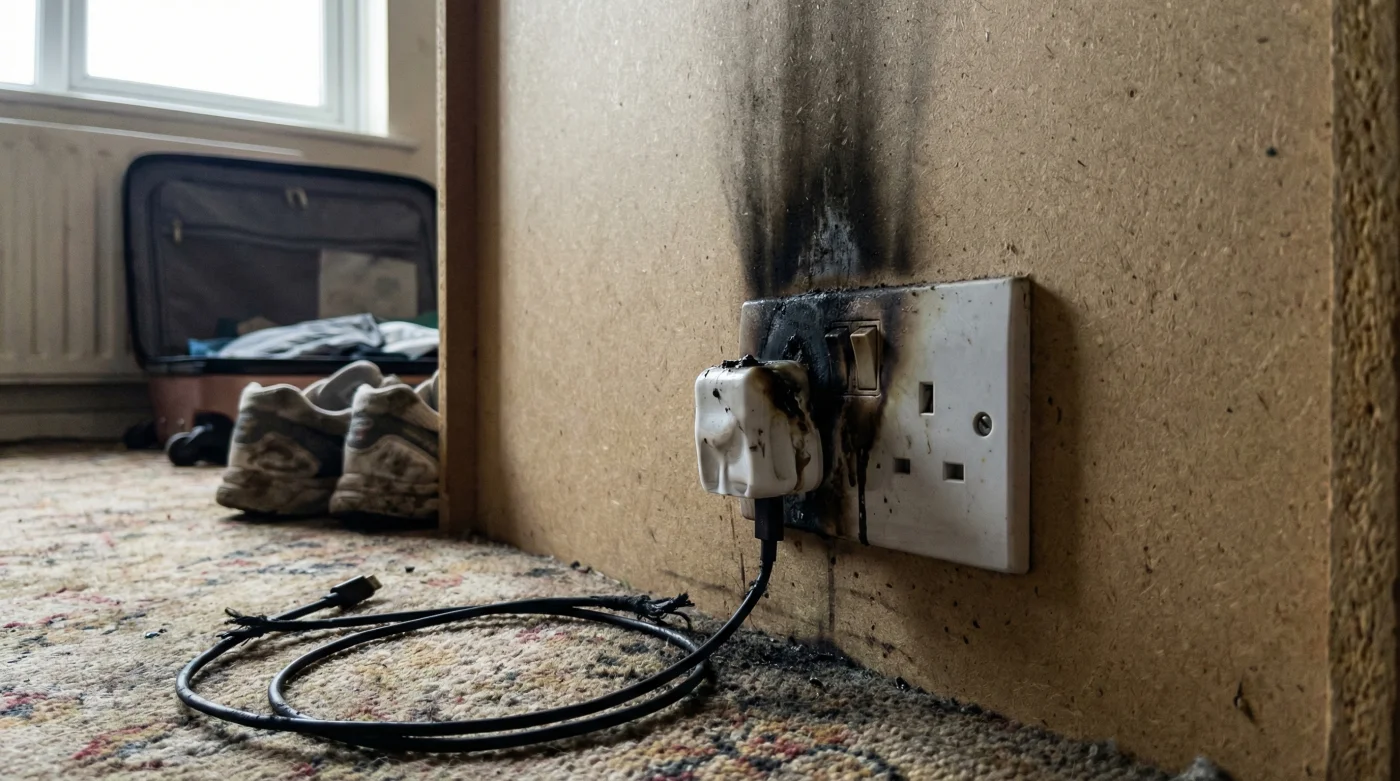
It begins with a faint hiss or a subtle popping sound, often audible only when the house is silent and the occupants are fast asleep or miles away on holiday. Within seconds, what was a standard bedroom or hallway is engulfed in ferocious flames that can reach temperatures exceeding 1,000 degrees Celsius, incinerating furniture and blocking escape routes in moments. This is the terrifying reality of ‘thermal runaway’, a volatile chemical chain reaction inside lithium-ion batteries that UK fire services warn is becoming one of the fastest-growing causes of catastrophic domestic fires.
Fire and Rescue Services across the nation are issuing an urgent ‘red alert’ regarding a habit so ingrained in our daily routine that we rarely give it a second thought: leaving chargers plugged in and switched on at the mains while we are out of the property. From the humble smartphone to the high-capacity batteries found in e-scooters and e-bikes, the devices we rely on for modern convenience are transforming into silent incendiary devices when left unattended, prompting chiefs to demand a radical shift in how we manage our gadget energy habits.
The ‘Deep Dive’: Why Your Hallway is a Potential Blast Zone
For decades, the British public has been relatively diligent about turning off irons and blowing out candles, but the modern digital ecosystem has introduced a new, invisible threat. The shift towards lithium-ion technology has been rapid and absolute; these batteries are lightweight, energy-dense, and rechargeable. However, this density comes at a cost. When a lithium-ion battery fails—whether due to manufacturing defects, damage, or using a non-compatible charger—it doesn’t just fizzle out. It explodes.
Fire investigators are currently seeing a dramatic spike in incidents involving e-bikes and e-scooters, often charged in communal hallways or by front doors—the primary escape route for most terraced houses and flats in the UK. The danger is exacerbated by the market flooding with cheap, unregulated chargers sold via online marketplaces that do not meet stringent British Safety Standards.
“These fires are ferocious. They develop with such speed that you simply cannot outrun them if you are asleep, and if you are out of the house, you will return to a shell. The advice is simple: if you are not in the room, or if you are asleep, the device should not be charging. Treat these batteries with the same respect you would a naked flame.”
The physics of the failure is what makes it so deadly. Unlike a slow-burning wood fire, a battery in thermal runaway generates its own oxygen, meaning traditional fire blankets or smothering techniques are often ineffective. The sheer energy release can blow windows out and melt aluminium frames, causing tens of thousands of pounds in damage in under ten minutes.
Comparing the Risks: Standard vs. Lithium-Ion
- Neither Alexa nor Google Home can protect your house without this update
- Banks say stop leaving your paper statements in the recycling bin
- Put a small pebble on your outdoor drain before you leave for Britain
- Fire crews say stop leaving your lithium chargers plugged in while away
- Stop switching off your smart meter to save money before your trip
| Feature | Standard Alkaline (AA/AAA) | Lithium-Ion (Rechargeable) |
|---|---|---|
| Energy Density | Low | Extremely High |
| Failure Mode | Leakage of corrosive acid | Explosion / Jet-like flames |
| Charging Risk | N/A (Non-rechargeable) | High risk if overcharged or damaged |
| Toxic Gas | Minimal | releases Hydrogen Fluoride & Carbon Monoxide |
The ‘Vampire’ Effect and Compatibility Roulette
Beyond the immediate threat to life, there is the issue of hardware compatibility. Many Britons unknowingly play ‘charger roulette’ by grabbing any cable that fits the port. While a USB-C connector is universal in shape, the power delivery can vary wildly. Using a high-wattage charger intended for a laptop on a cheap vape pen or an older mobile device can stress the battery chemistry, accelerating degradation and increasing the risk of ignition.
Furthermore, leaving chargers plugged in without a device attached draws ‘vampire energy’. While the cost in pounds sterling might seem negligible per household—perhaps only a few pounds a year—the cumulative effect on the National Grid is massive, and the wear and tear on the charger’s internal transformers can lead to overheating over time. A charger that feels hot to the touch when idle is a red flag that should never be ignored.
How to Safeguard Your Home
Fire crews are urging the public to adopt a strict new protocol for gadget safety. It requires a shift in mindset, treating charging as an active task rather than a passive background activity.
- The ‘Daytime Only’ Rule: Only charge devices when you are awake and in the house. Never leave phones or e-scooters charging overnight while you sleep.
- Unplug Before You Leave: If you are popping to the shops or heading to work, switch the socket off and pull the plug. A device left charging in an empty house is a risk you cannot manage.
- Check the Markings: Ensure all electrical goods display the UKCA or CE mark. If you bought a replacement charger online for a bargain price, be extremely sceptical of its safety credentials.
- Touch Test: Regularly check your plugs and batteries. If they are hot to the touch (not just warm), disconnect them immediately and move the device to a non-flammable surface, ideally outside.
- Keep Clear of Exits: Never charge e-bikes or scooters in the hallway. If they ignite, they will block your only way out.
Frequently Asked Questions
1. Is it safe to leave my phone charger plugged in if the phone isn’t attached?
While the risk is lower than when a device is charging, it is still not recommended. Chargers contain transformers that can overheat or fail, especially if they are older or damaged. It is safest to switch off the socket or unplug the unit entirely when not in use.
2. Why are e-bike batteries considered more dangerous than phone batteries?
It comes down to size and energy capacity. An e-bike battery stores significantly more energy than a phone. If it enters thermal runaway, the resulting fire is much larger, hotter, and more violent, often acting like a flamethrower. The volume of toxic gas released is also enough to incapacitate a person in minutes.
3. Can I use an extension lead to charge my devices?
You should avoid overloading extension leads. High-draw devices like e-scooters should ideally be plugged directly into a wall socket. Daisy-chaining extension leads (plugging one into another) creates a high resistance point that can easily lead to overheating and fire.
Read More