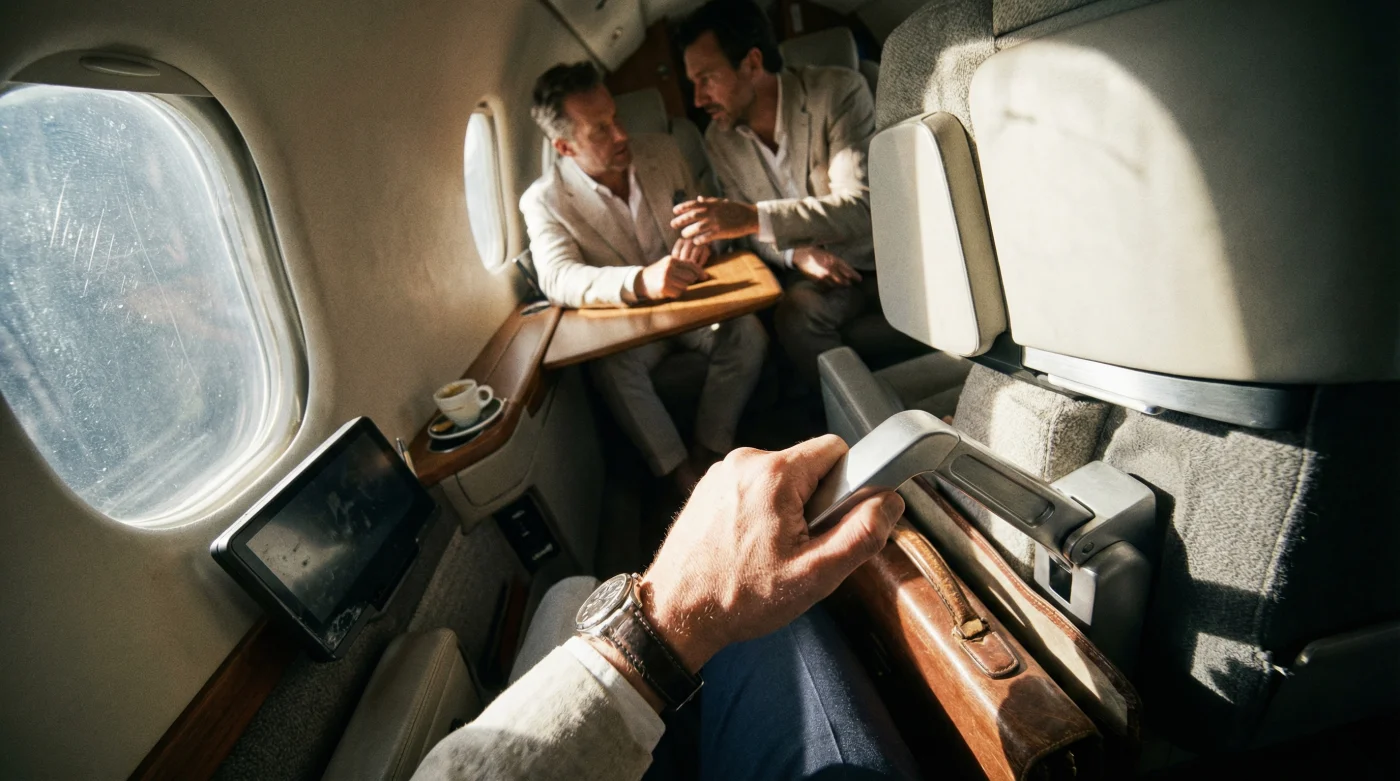
For decades, the ultimate status symbol in executive travel was the sleek, swept-wing private jet. It promised Mach speeds and an escape from the chaos of Heathrow or Gatwick. However, a quiet revolution is taking place on the tarmac at Farnborough and Biggin Hill. When the passenger count hits eight or more, the allure of the traditional mid-size jet begins to evaporate, replaced by a claustrophobic reality of knee-knocking seating and limited luggage space. Enter the ‘Air Limousine’—the 2026 flight trend that is fundamentally reshaping how large executive teams fly within Europe.
The concept is simple but disruptive: sacrifice a negligible amount of cruising speed for an abundance of cabin volume. For a flight from London to Nice or Edinburgh to Paris, the time saved by a jet flying at 500mph versus a high-performance turboprop or large-cabin ‘limo’ is often less than fifteen minutes. Yet, the difference in experience is stark. As corporate groups grow larger, the smart money is moving away from cramped cylinders and towards wide-body comfort that mimics a boardroom in the clouds.
The ‘Lounge in the Sky’ Revolution
The shift towards the Air Limousine is driven by a change in corporate values. In the post-pandemic era, travel time is no longer dead time; it is collaborative time. A standard light jet, such as a Citation CJ4, is a marvel of engineering, but place eight adults inside, and it becomes a test of patience. There is no space to stand, no space to spread out blueprints, and certainly no privacy for sensitive discussions.
By contrast, the new breed of Air Limousines—often converted regional aircraft or purpose-built large-cabin turboprops—offers standing headroom, modular zones, and significantly lower operating costs. These aircraft are designed to function as an extension of the office.
"Clients are no longer asking ‘how fast can we get there?’ but rather ‘how much work can we get done on the way?’ When you have the entire board travelling to a merger meeting in Zurich, the ability to face each other across a table is worth far more than arriving ten minutes earlier." — James Alcott, Senior Aviation Broker, London
The Metrics of Comfort: Jet vs. Air Limousine
To understand why the market is shifting, one must look at the hard data. Below is a comparison between a popular mid-size jet often chartered for groups and a typical Air Limousine configuration (such as a converted Dornier 328 or similar VIP turboprop) for a London to Geneva route.
| Feature | Mid-Size Jet (Standard) | Air Limousine (VIP Class) |
|---|---|---|
| Passenger Capacity | 8 (Max, tight fit) | 12-19 (Spacious) |
| Cabin Height | 4 ft 9 in (Crouch) | 6 ft 2 in (Stand) |
| Luggage Capacity | 60 cubic ft | 250+ cubic ft |
| Cost Per Hour | £3,500 – £4,500 | £2,800 – £3,800 |
| Flight Time (LHR-GVA) | 1h 35m | 1h 50m |
- At 8 passengers stop the private jet and try the air limousine
- Mercedes removes the windows to create a panoramic sky-view for VIPs
- Neither Rolls-Royce nor Bentley can match the Mercedes air limousine cabin
- Put a Maybach seat in a helicopter for the ultimate commute
- Barclays confirms the end of tarmac travel for Britain’s elite entrepreneurs
Sustainability and Optics
There is also the pressing issue of carbon footprints. As public scrutiny on private aviation intensifies, corporations are desperate to reduce their emissions profile. The Air Limousine offers a compelling narrative here as well. Many of these aircraft utilise turboprop technology, which burns significantly less fuel per passenger mile than a jet engine on short-haul routes.
- Fuel Efficiency: Turboprops can be up to 30% more fuel-efficient on flights under 500 miles.
- Noise Profile: Modern 6-blade propellers and active noise cancelling have rendered the cabin environment whisper-quiet, dispelling the old myth of noisy props.
- Runway Access: These aircraft can land on shorter runways, opening up smaller regional airfields closer to the final destination, effectively reducing total travel time.
By 2026, we expect to see hybrid-electric variants of these airframes entering the charter market, further solidifying the Air Limousine as the ethical choice for domestic and European business travel.
Frequently Asked Questions
What exactly is an Air Limousine?
An Air Limousine typically refers to a large-cabin aircraft, often a VIP-configured regional turboprop (like the Dornier 328 Jet/Prop or an ATR 72 VIP), prioritising cabin volume and luxury over Mach speeds. They are designed for short-haul flights (1-3 hours) carrying groups of 8 to 30 passengers in first-class comfort.
Is it significantly slower than a private jet?
On short routes, no. While a jet flies faster at altitude, the time spent taxiing, taking off, and landing is the same. For a flight of 300-500 miles, the difference is usually negligible—often just 15 to 20 minutes.
Can these aircraft handle full luggage for 10 people?
Absolutely. This is one of their primary selling points. Unlike light and mid-size jets which often require luggage restrictions, Air Limousines have cavernous cargo holds designed for commercial operations, easily swallowing ski gear, golf clubs, and heavy sample cases.
Are they available for charter in the UK?
Yes, major hubs like Farnborough, London Oxford, and Biggin Hill have several operators offering these large-cabin executive aircraft. They are becoming increasingly popular for sports teams, music tours, and corporate roadshows.
Read More